
Self-employed borrowers in Ashland, Hanover County, and across Virginia face a genuinely tougher mortgage path than W-2 employees. Not because they earn less, but because their income looks different on paper. Tax write-offs that reduce your tax bill also reduce your qualifying income. Two-year averages can punish a strong recent year. And a hard credit inquiry at the wrong lender can cost you points before you even get a real answer.
The good news: the right combination of tools, loan programs, and broker access can flip most of these challenges into manageable steps. Whether you’re a freelancer in Mechanicsville, a business owner in Doswell, or a real estate investor in Montpelier, these tools are worth knowing before you apply.
1. Ashland Mortgage — NoTouch Credit Pre-Approval (Coast2Coast Mortgage LLC)
Best for: Self-employed borrowers in Hanover County who need pre-approval without a hard credit inquiry
Ashland Mortgage is an independent mortgage broker serving Ashland VA and Hanover County with access to 500+ wholesale lenders and a proprietary NoTouch Credit Pull system built specifically for borrowers who can’t afford to shop blindly.

Where This Tool Shines
For self-employed borrowers, the pre-application phase is the most dangerous. Walk into a retail bank or national lender and they’ll run a hard inquiry before telling you whether you even qualify. If you visit two or three lenders, those pulls stack up. Ashland Mortgage’s NoTouch Credit Pull uses a soft inquiry instead, so you get a real pre-approval assessment with zero score impact.
The broker model matters here too. Duane Buziak, NMLS #1110647, doesn’t have one bank’s program to sell you. He has access to 500+ wholesale lenders, which means bank statement loans, Non-QM programs, USDA, VA, FHA, and conventional options are all on the table. A retail banker like Randy Rodgers at First Bank can only offer what First Bank has. That’s a meaningful difference when your income doesn’t fit a standard W-2 box.
Key Features
NoTouch Credit Pull: Soft-pull pre-approval with no score impact, critical for self-employed borrowers who are rate-shopping or unsure of their eligibility before committing to a full application.
500+ Wholesale Lenders: Access to bank statement loan programs, Non-QM products, and specialty programs unavailable at retail banks like C&F Mortgage or through national call-center lenders like Rocket Mortgage.
USDA and VA Expertise: Deep familiarity with rural-eligible pockets in Hanover County and the VA residual income calculation that benefits self-employed veterans specifically.
Pre-Application Income Analysis: Dedicated review of your self-employment income structure before you apply, so there are no surprises at underwriting.
Local Ashland Presence: Personalized service from a broker who knows which neighborhoods in Hanover County qualify for USDA, which streets affect VA appraisals, and how the Richmond commuter market is priced.
Best For
Self-employed borrowers in Ashland VA, Hanover County, Mechanicsville, Doswell, Montpelier, and Beaverdam who want to understand their real options before triggering a hard credit pull. Particularly valuable for business owners with significant write-offs, veterans, and buyers considering USDA-eligible properties.
Pricing
No upfront cost for the pre-approval consultation. Broker fees are disclosed at application per federal RESPA requirements. No-out-of-pocket closing options may be available depending on loan program and structure.
2. IRS Income Verification Express Service (IVES)
Best for: Self-employed borrowers who want to review their own tax transcripts before a lender does
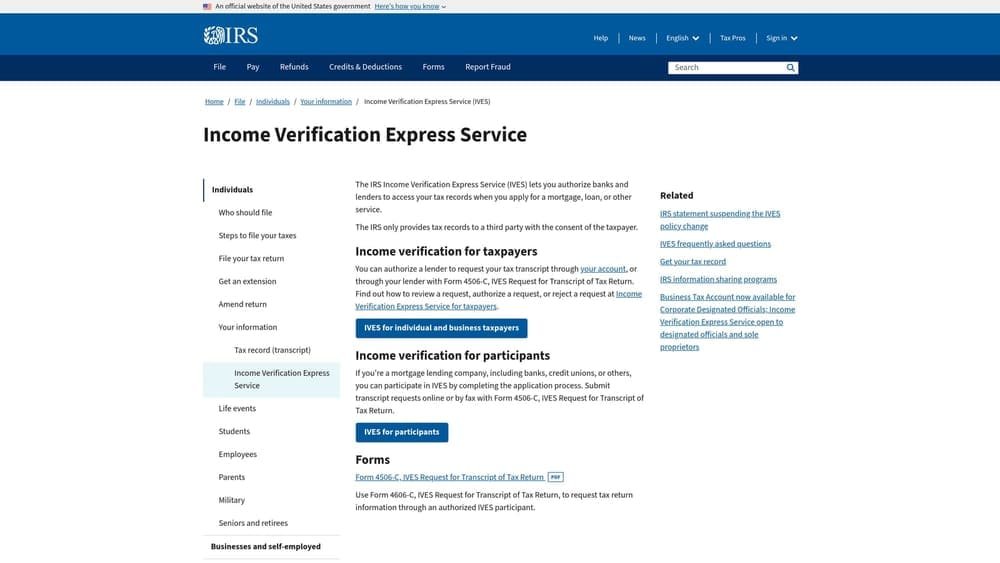
IRS IVES is the official IRS transcript delivery system that allows lenders and borrowers to pull Form 4506-C tax transcripts directly — the primary income verification document required for every self-employed mortgage applicant.
Where This Tool Shines
Most self-employed borrowers don’t know what a lender will see until underwriting. By pulling your own transcripts through IVES first, you can review the exact income figures a lender will use to calculate your qualifying income. Discrepancies between what you think you filed and what the IRS has on record are more common than people expect, and catching them before application saves weeks of delay.
Transcript delays are also a real underwriting bottleneck. When borrowers have transcripts ready before the application, processing moves faster. For self-employed buyers targeting a specific closing date, that head start matters.
Key Features
Official Form 4506-C Transcripts: The exact document every conventional, FHA, VA, and USDA lender requires for self-employed income verification — pulled directly from the IRS.
Self-Review Before Application: Borrowers can pull their own records to see what lenders will see, identifying any discrepancies in advance.
Discrepancy Detection: Identifies gaps between filed returns and lender-submitted documents before underwriting flags them.
Faster Underwriting: Transcripts ready at application submission reduce back-and-forth with the IRS during processing.
Two-Year Income Visibility: Allows borrowers to see both years of income that conventional lenders will average — and decide whether the timing of their application is optimal.
Best For
Any self-employed borrower preparing for a mortgage application. Especially valuable for business owners who have had complex tax years, amended returns, or who want to verify their income picture before meeting with a broker.
Pricing
Free for individual taxpayers requesting their own records through IRS.gov.
3. QuickBooks Self-Employed
Best for: Freelancers and sole proprietors who need lender-ready P&L statements for bank statement or Non-QM loan applications
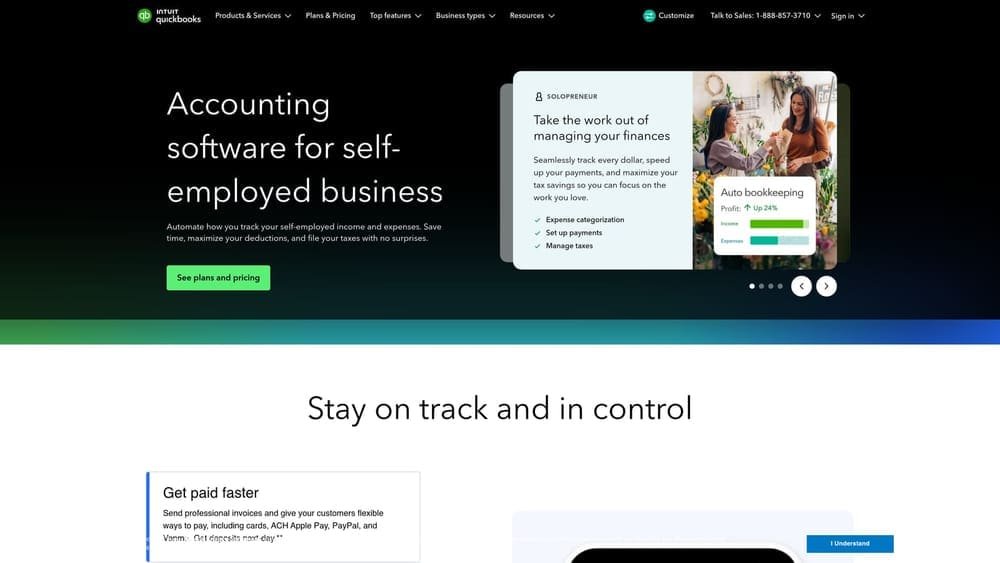
QuickBooks Self-Employed is Intuit’s accounting and expense-tracking platform designed for freelancers and sole proprietors, capable of generating profit-and-loss statements that lenders accept for bank statement and Non-QM loan applications.
Where This Tool Shines
Bank statement loan programs require a CPA-prepared or borrower-prepared P&L statement alongside 12 or 24 months of bank deposits. QuickBooks Self-Employed generates that P&L automatically from your connected bank accounts and transaction categorization. It’s not a replacement for a CPA, but it gives you a real-time view of your income picture throughout the year — not just at tax time.
The write-off visibility is particularly useful for mortgage planning. QuickBooks shows you exactly how much your deductions are reducing your net income, which directly correlates to how much qualifying income a lender will see on your tax return. That visibility lets you make informed decisions about deduction strategy in the years before you apply.
Key Features
Lender-Ready P&L Statements: Generates profit-and-loss reports formatted for bank statement loan applications and Non-QM underwriting review.
Automatic Income Separation: Separates business and personal income via bank feed integration, keeping records clean for underwriting.
Deduction Tracking: Tracks deductible expenses and helps borrowers understand the direct trade-off between write-offs and qualifying income.
Year-Over-Year Trend Reports: Income stability reports across multiple years are useful for demonstrating consistent earnings to underwriters.
Mobile Tracking: Real-time income and expense logging throughout the year, not just at tax season.
Best For
Freelancers, consultants, sole proprietors, and gig workers in the Richmond metro area who are 12 to 24 months away from applying for a mortgage and want to build a clean, documentable income record.
Pricing
Starts at approximately $15/month for the Self-Employed tier. Pricing is subject to change; verify current rates at quickbooks.intuit.com.
4. Fannie Mae Self-Employed Income Worksheet (Form 1084)
Best for: Self-employed borrowers who want to calculate their own qualifying income before approaching a lender
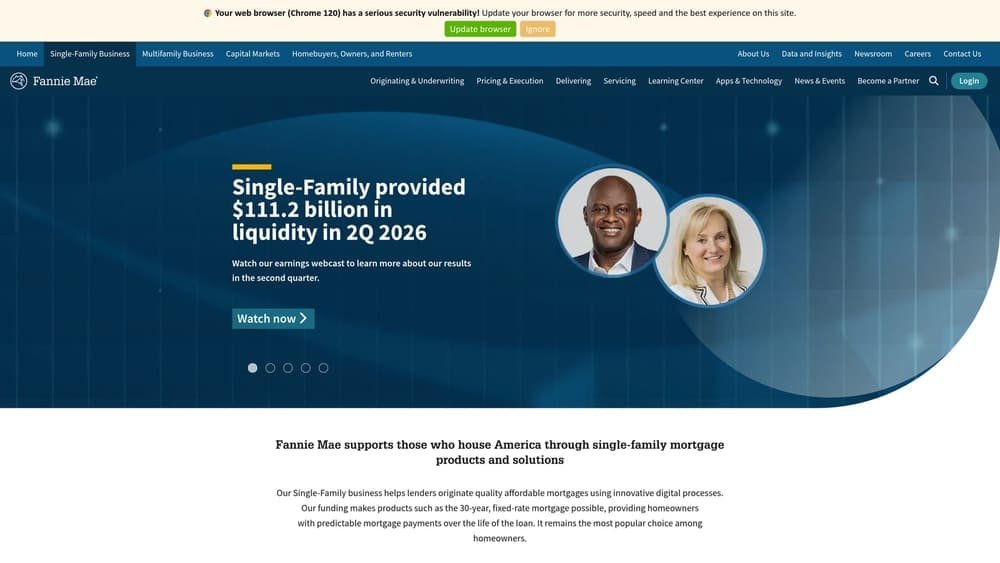
Fannie Mae Form 1084 is the official cash flow analysis worksheet that conventional loan underwriters use to calculate qualifying income from self-employment tax returns — available free to the public so borrowers can run their own numbers first.
Where This Tool Shines
Most self-employed borrowers walk into a mortgage application without knowing what number an underwriter will arrive at. Form 1084 is the exact worksheet a conventional underwriter uses. Downloading it and working through it with your own tax returns before you apply tells you precisely what qualifying income figure to expect — and whether a one-year or two-year average produces a better result for your situation.
This tool also helps you have a more productive conversation with a broker. When you already understand how your Schedule C, Schedule E, or K-1 income is being treated, you can ask sharper questions about whether a Non-QM bank statement program would produce a higher qualifying number than the conventional calculation.
Key Features
Exact Underwriter Worksheet: The same form conventional loan underwriters use — no guessing, no approximations.
Multi-Schedule Coverage: Covers Schedule C (sole proprietor), Schedule E (rental income and S-Corp), Schedule F (farm), and K-1 distributions.
Free PDF Download: Available directly from Fannie Mae’s single-family resource library at no cost.
One-Year vs. Two-Year Comparison: Allows borrowers to calculate both scenarios and identify which averaging period produces the higher qualifying income.
Pre-Application Clarity: Removes the guesswork about what income figure a lender will use before you trigger any credit inquiry.
Best For
Self-employed borrowers with complex tax returns who want to model their own qualifying income before meeting with a broker. Especially useful for S-Corp owners, partners in LLCs, and Schedule C filers with significant depreciation or business-use deductions.
Pricing
Free. Official Fannie Mae public resource.
5. USDA Rural Development Property Eligibility Map
Best for: Self-employed buyers in Hanover County targeting zero-down financing on rural-eligible properties
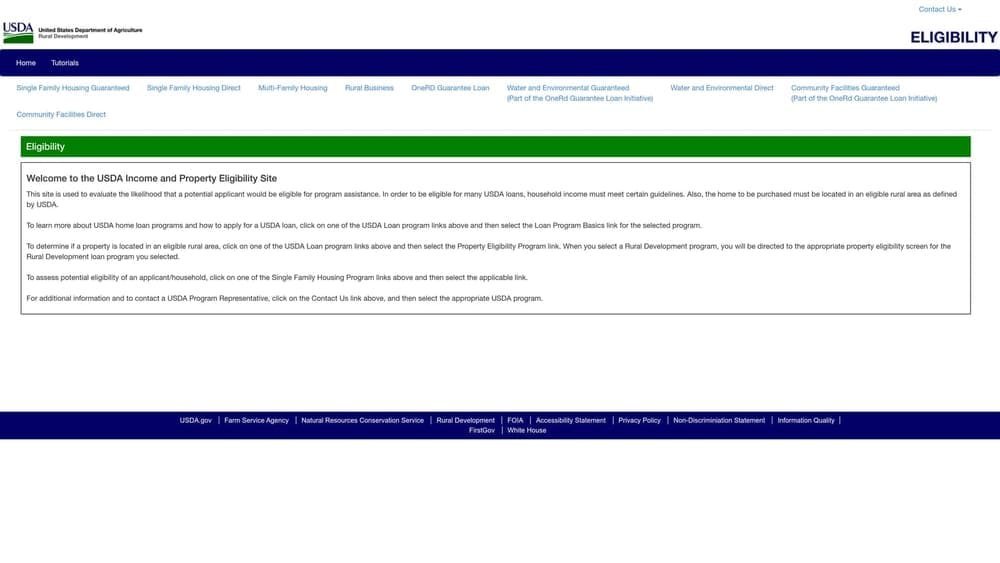
The USDA Rural Development Property Eligibility Map is the official USDA tool that lets buyers check whether a specific property address qualifies for a USDA Rural Development loan, which requires zero down payment and is available in rural-eligible pockets of Hanover County.
Where This Tool Shines
Self-employed borrowers often have strong income but limited liquid cash reserves because capital stays in the business. USDA’s zero-down structure removes the biggest cash barrier to homeownership for eligible buyers. The challenge is knowing whether a specific property qualifies — and that’s exactly what this map answers in about 30 seconds.
Ashland’s ZIP code 23005 and surrounding areas including Doswell, Montpelier, and Beaverdam have rural-eligible pockets that many buyers don’t know about. Properties just outside Ashland’s core may qualify even when the town center does not. The map is the only authoritative source — and it’s free.
Key Features
Address-Level Eligibility Lookup: Enter any Hanover County address to get an instant USDA eligibility determination.
Hanover County Coverage: Ashland ZIP 23005 and surrounding rural areas have eligible pockets — the map identifies them precisely.
Zero Down Payment Benefit: Critical for self-employed buyers with strong income but limited cash reserves who can qualify on income but struggle with a large down payment.
Income Eligibility Calculator: The same platform includes a household income eligibility tool to confirm you meet USDA income limits for Hanover County.
Official and Current: Updated by USDA as eligibility boundaries are revised — the only source you should rely on.
Best For
Self-employed buyers targeting properties in Doswell, Montpelier, Beaverdam, or rural Hanover County who want to eliminate the down payment requirement. Pairs directly with Ashland Mortgage’s USDA loan expertise for a complete zero-down path.
Pricing
Free tool. The USDA loan itself has no down payment requirement; a guarantee fee applies and can typically be rolled into the loan amount.
6. VA.gov Home Loan Eligibility Portal
Best for: Self-employed veterans in Ashland and Hanover County who want to verify VA entitlement and understand residual income qualification
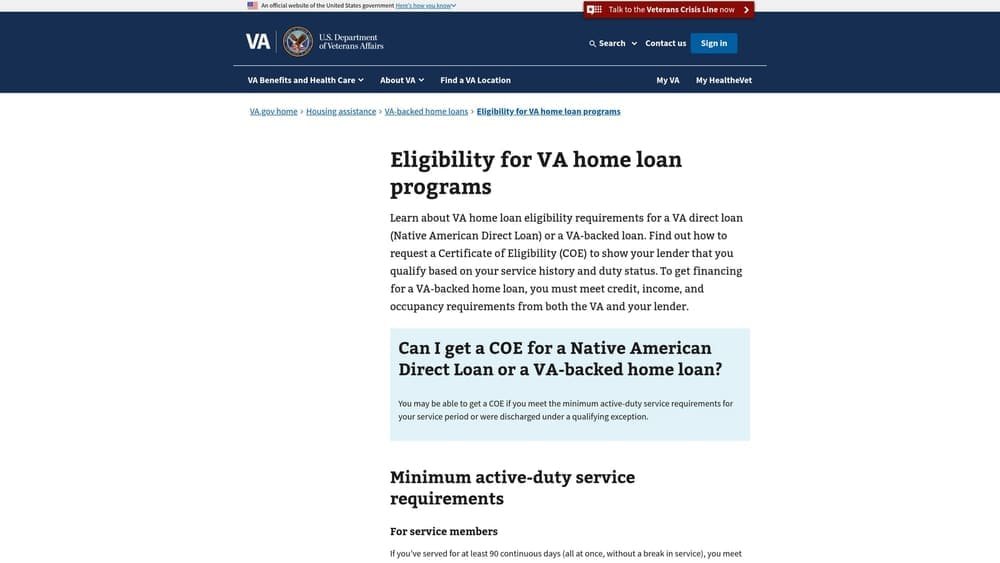
The VA.gov Home Loan Eligibility Portal is the U.S. Department of Veterans Affairs’ official system for verifying VA entitlement and generating a Certificate of Eligibility — particularly valuable for self-employed veterans whose income may qualify more favorably under VA’s residual income standard.
Where This Tool Shines
VA loans use a residual income calculation in addition to standard debt-to-income ratios. For self-employed veterans whose taxable income is reduced by write-offs, the residual income standard can be more forgiving than a strict DTI calculation on tax return income. Understanding this distinction before you apply can be the difference between a denial and an approval.
The 2026 conforming loan limit of $806,500 means most Hanover County purchases fall well within VA’s no-down-payment threshold. And with no private mortgage insurance requirement, a VA loan can produce a meaningfully lower monthly payment than a conventional loan with the same rate and purchase price.
Key Features
Certificate of Eligibility (COE): Confirms VA entitlement and generates the COE required to begin a VA loan application.
Residual Income Advantage: VA’s residual income standard can benefit self-employed veterans with strong gross income that’s reduced on paper by legitimate deductions.
No Down Payment: VA loans require no down payment on purchases up to the 2026 conforming limit of $806,500 baseline.
No PMI: Eliminates private mortgage insurance entirely, a significant monthly savings compared to conventional financing with less than 20% down.
VA Cash-Out Refinance: Available up to 100% LTV for eligible veterans who want to access equity after purchase.
Best For
Self-employed veterans in Ashland VA and Hanover County who have VA entitlement and want to understand how their income will be evaluated under VA guidelines before applying. Also valuable for active-duty service members relocating to the Richmond metro area.
Pricing
Free eligibility check. A VA funding fee applies to most loans and may be waived for veterans with a qualifying service-connected disability.
7. CFPB Mortgage Application Preparation Checklist
Best for: First-time self-employed homebuyers who want an unbiased, government-published document checklist before starting the application process
The CFPB’s Owning a Home preparation guide is the Consumer Financial Protection Bureau’s plain-language resource for mortgage applicants, including a document checklist that covers the expanded paperwork self-employed borrowers must gather beyond standard W-2 documentation.
Where This Tool Shines
There’s no lender agenda here. The CFPB is a federal consumer protection agency, and this checklist was written to help borrowers, not to sell them a product. For self-employed buyers who are new to the mortgage process, that neutrality is valuable. It tells you exactly what you’ll need to gather without any of the upsell pressure that can come from lender-published guides.
The self-employment-specific documentation list is comprehensive: two years of business returns, a year-to-date P&L, business bank statements, and more. Knowing this list before you start organizing your records saves significant time and prevents the last-minute scramble that delays closings.
Key Features
Government-Published, Unbiased: No lender interest behind the content — written to protect and inform borrowers.
Self-Employment Document Coverage: Explicitly covers business tax returns, YTD profit-and-loss statements, and business bank statements beyond standard W-2 requirements.
Plain-Language Explanations: Explains why each document is required, not just what to provide.
Interactive Owning a Home Tool: The broader CFPB platform includes a rate explorer and loan comparison features for additional research.
Regularly Updated: Maintained by the federal consumer protection agency and updated as mortgage guidelines evolve.
Best For
First-time self-employed homebuyers in Ashland and Hanover County who want to understand the full documentation picture before their first conversation with a broker. A strong starting point before using any of the other tools on this list.
Pricing
Free. Federal government resource with no registration required.
8. Experian Boost
Best for: Self-employed borrowers with thin credit files or scores just below key mortgage rate thresholds
Experian Boost is Experian’s free credit enhancement tool that adds on-time utility, phone, and subscription payment history to an Experian credit report, potentially improving scores for borrowers who have limited traditional credit history.
Where This Tool Shines
Newer business owners often have thinner credit files than long-tenured employees. If you’ve been building a business for two or three years and most of your financial activity has been through business accounts, your personal credit history may be sparser than your income would suggest. Experian Boost can add payment history from utilities, streaming services, and phone bills that wouldn’t otherwise appear on your report.
The timing matters. A score improvement before a hard pull means better rate tiers at application. Even a modest score improvement can move a borrower from one pricing band to another, affecting the rate offered across the life of a 30-year loan. Use this before you apply, not after.
Key Features
Utility and Subscription History: Adds on-time payments for utilities, streaming services, and phone bills to Experian credit history — free and immediate for eligible users.
Thin File Solution: Particularly useful for newer business owners who have less traditional revolving credit history.
Pre-Application Score Improvement: Score improvement before a hard pull can mean better pricing tiers at application.
No Cost, No Card Required: Free to use with no credit card required for enrollment.
Experian-Specific: Works only on your Experian score — pair with monitoring of all three bureaus (Equifax and TransUnion as well) before applying.
Best For
Self-employed borrowers in the early stages of business ownership who have strong income but a thinner credit file, and borrowers whose scores are just below a meaningful rate threshold (for example, approaching the 740 or 760 tiers that often unlock better conventional pricing).
Pricing
Free. No subscription or credit card required for the core Boost feature.
9. Stride Tax (Deduction and Income Tracker for Self-Employed)
Best for: Gig workers, delivery drivers, and freelancers who need to model the mortgage impact of their deduction strategy before applying
Stride Tax is a free mobile app designed for gig workers and freelancers that tracks mileage, deductions, and estimated tax obligations — and critically, helps self-employed borrowers understand the trade-off between maximizing write-offs and maintaining sufficient qualifying income for a mortgage.
Where This Tool Shines
The write-off penalty is one of the most frustrating self-employed mortgage challenges. Every dollar you deduct legitimately reduces your tax bill — but it also reduces the qualifying income a lender sees. Stride makes that trade-off visible in real time, so you can make informed decisions about which deductions to take in the year or two before you plan to apply.
This is especially relevant for the rideshare and delivery driver community in the Richmond metro area, where mileage deductions can be substantial. Stride’s IRS-compliant mileage logs also serve as documentation if a lender asks for business records to support income claims on a bank statement loan application.
Key Features
Free Mileage Tracking: IRS-compliant mileage logs that serve dual purpose as tax documentation and potential lender evidence of business activity.
Deduction Impact Modeling: Helps borrowers understand how current deduction choices will affect qualifying income one to two years before applying for a mortgage.
Tax Savings vs. Mortgage Qualification Trade-Off: Visualizes the real cost of write-offs in mortgage qualification terms, not just tax savings terms.
Tax Filing Integration: Integrates with major tax filing platforms for year-end reporting, keeping records consistent across documents a lender will review.
Mobile-First Design: Built for gig workers and delivery drivers who track expenses on the go throughout the workday.
Best For
Gig economy workers, rideshare and delivery drivers, and freelancers in the Richmond metro area who are planning a home purchase 12 to 24 months out and want to optimize their income documentation strategy before filing the tax returns that will determine their qualifying income.
Pricing
Free core app. Premium features are available at additional cost.
Which Tool Is Right for Your Situation
Every self-employed borrower’s challenge is a little different. Here’s how to think about pairing these tools to your specific situation before you start the application process.
If you’re starting from scratch: Begin with the CFPB checklist to understand what documents you’ll need, then pull your IRS transcripts through IVES to see what a lender will see. Then contact Ashland Mortgage for a NoTouch Credit pre-approval before any hard inquiry touches your file.
If your tax return income is too low due to write-offs: Use Fannie Mae Form 1084 to calculate your conventional qualifying income, then compare it against a bank statement loan scenario through Ashland Mortgage’s wholesale lender access. The delta between those two numbers is the core reason Non-QM programs exist.
If you’re a veteran: Check your eligibility at VA.gov first. VA’s residual income standard is often more favorable for self-employed veterans than conventional DTI underwriting. No down payment and no PMI make this the strongest program available if you qualify.
If you have limited cash reserves: Check USDA eligibility for your target property at the USDA eligibility map. Rural-eligible pockets in Doswell, Montpelier, and Beaverdam can eliminate the down payment entirely.
The Write-Off Penalty in Real Numbers
Here’s a worked example that illustrates why the right loan program matters for self-employed buyers in Ashland. This is a real calculation, not a hypothetical range.
Scenario: Self-employed borrower in Ashland VA, targeting a $375,000 purchase price. Two-year average tax return income after write-offs: $52,000/year. Gross bank deposits over 12 months: $96,000.
Conventional loan on tax return income: At $52,000 annual qualifying income, the monthly gross income is approximately $4,333. At a 43% maximum DTI, the maximum total monthly debt payment is approximately $1,863. Subtract estimated taxes and insurance on a $375,000 home (approximately $375/month combined estimate) and any existing monthly debts, and the maximum principal and interest payment the borrower can support is meaningfully constrained. At a 7.0% rate on a 30-year term, a $300,000 loan carries approximately $1,996/month in P&I alone — which exceeds what $52,000 income supports at 43% DTI with any existing debts.
Bank statement loan on deposit income: At $96,000 in annual gross deposits, the monthly qualifying income is $8,000. At 43% DTI, the maximum total monthly debt is approximately $3,440. A $375,000 purchase with 10% down ($337,500 loan) at 7.5% on a 30-year term carries approximately $2,360/month in P&I — well within range at this income level, even with moderate existing debts.
The delta: The same borrower, the same income, the same property. On a tax return, they may not qualify for the purchase at all. On a bank statement loan, they qualify comfortably. This is why broker access to Non-QM programs matters, and why a NoTouch Credit pre-approval through Ashland Mortgage is the right first step — not a hard inquiry at a retail bank that only offers conventional products.
Down payment comparison on the same $375,000 purchase:
USDA (rural-eligible property): $0 down. Guarantee fee of 1% upfront ($3,750 on $375,000) plus 0.35% annual fee, both of which can be rolled into the loan.
FHA: 3.5% down = $13,125. Mortgage insurance premium applies for the life of the loan in most cases.
Conventional: 5% down = $18,750. PMI applies until 20% equity is reached. 10% down = $37,500, with lower PMI.
For a self-employed buyer with strong income but capital tied up in a business, the USDA zero-down path on an eligible Hanover County property is often the most practical route to ownership.
Broker vs. Bank: What It Means for Self-Employed Borrowers
| Feature | Duane Buziak / Coast2Coast Mortgage | Rocket Mortgage | C&F Mortgage / Valerie Holbrook | Movement Mortgage |
|---|---|---|---|---|
| Broker or Retail Lender | Independent Mortgage Broker | Retail Lender (National) | Retail Lender (Local) | Retail Lender (National) |
| Wholesale Lender Access | 500+ wholesale lenders | Single lender (Rocket) | Single lender (C&F) | Single lender (Movement) |
| NoTouch Soft Credit Pull | Yes — no score impact | No — hard pull required | No — hard pull required | No — hard pull required |
| Bank Statement / Non-QM Loans | Yes — multiple wholesale programs | Limited | Limited | Limited |
| USDA Loan Availability | Yes — Hanover County expertise | Yes — limited local knowledge | Yes — some programs | Yes — limited local knowledge |
| VA Loan Availability | Yes — 100% LTV cash-out available | Yes | Yes | Yes |
| Local Ashland / Hanover Knowledge | Yes — community-based broker | No — national call center | Partial — Henrico/Hanover corridor | No — national retail |
| Self-Employed Income Pre-Analysis | Yes — before application | At application only | At application only | At application only |
Frequently Asked Questions
Can I get a mortgage if I’ve been self-employed for only one year?
It is more difficult but not impossible. Most conventional and FHA lenders require two years of self-employment history. However, some Non-QM and bank statement loan programs through wholesale lenders may consider borrowers with one year of self-employment, particularly if the borrower was previously employed in the same field. A mortgage broker with access to multiple wholesale lenders — rather than a single retail bank — has more program options to explore for one-year self-employed borrowers.
How do lenders calculate income for self-employed borrowers?
For conventional and government loans, lenders use IRS tax transcripts and apply the Fannie Mae Form 1084 cash flow analysis to determine qualifying income. This typically means taking your net profit after deductions from Schedule C, adding back certain non-cash expenses like depreciation, and averaging the result over two years. For bank statement loans, lenders instead use 12 or 24 months of gross bank deposits, often applying a percentage factor to account for business expenses. The qualifying income figure can differ significantly between these two methods.
What is a bank statement loan and how does it help self-employed buyers?
A bank statement loan is a Non-QM (non-qualified mortgage) product that allows self-employed borrowers to qualify based on 12 or 24 months of bank deposits rather than tax return income. This directly addresses the write-off penalty: borrowers whose legitimate business deductions reduce their taxable income to a level that won’t support a conventional loan can often qualify on their actual cash flow instead. Bank statement loans typically carry slightly higher rates than conventional products, but they open homeownership to borrowers who would otherwise be declined.
Does the NoTouch Credit Pull count as a hard inquiry?
No. Ashland Mortgage’s NoTouch Credit Pull uses a soft inquiry, which does not affect your credit score and does not appear to other lenders as an inquiry. This allows self-employed borrowers to get a genuine pre-approval assessment — including program options and estimated qualifying income — without any score impact. Hard inquiries are only triggered when you formally apply for credit, which happens later in the process after you’ve reviewed your options and chosen a path forward.
Can self-employed borrowers qualify for a USDA loan in Hanover County?
Yes, provided the property is in a USDA rural-eligible area and the borrower meets USDA income limits for the area. Self-employment income is acceptable for USDA qualification; lenders will use tax return income (typically a two-year average) to verify eligibility. Ashland ZIP 23005 and surrounding areas including Doswell, Montpelier, and Beaverdam have rural-eligible pockets. Check any specific address at the USDA Rural Development eligibility map.
How many years of tax returns do I need for a mortgage?
Most conventional, FHA, VA, and USDA lenders require two years of personal tax returns and, if you own a business entity, two years of business returns as well. Some lenders may accept one year in limited circumstances. Bank statement loan programs bypass the tax return requirement entirely, using deposit history instead. Your broker can advise on which documentation path produces the strongest qualifying income for your specific situation.
What is the difference between a mortgage broker and a bank for self-employed borrowers?
A retail bank or direct lender offers only their own loan products, with their own underwriting overlays applied on top of agency guidelines. A mortgage broker like Duane Buziak at Coast2Coast Mortgage has access to 500+ wholesale lenders, meaning more program options — including bank statement loans, Non-QM products, and specialty programs that retail banks typically don’t offer. For self-employed borrowers whose income doesn’t fit a standard W-2 box, broker access to a wider range of programs is often the difference between an approval and a denial.
Can a self-employed veteran use a VA loan in Ashland VA?
Yes. VA loan eligibility is based on military service, not employment type. Self-employed veterans qualify for VA loans using their tax return income, with lenders applying VA’s residual income calculation in addition to standard DTI. VA’s residual income standard can be more favorable for self-employed veterans whose gross income is strong but whose taxable income is reduced by deductions. The 2026 baseline conforming limit of $806,500 covers most Hanover County purchases with no down payment required. Verify your eligibility and generate your Certificate of Eligibility at VA.gov.
Ready to Find Your Path Forward
Self-employment shouldn’t be a barrier to homeownership in Ashland, Mechanicsville, or anywhere in Hanover County. The tools on this list exist because the mortgage system was built around W-2 income — and the right resources help you navigate it on your own terms.
For most self-employed buyers, the smartest first step is understanding your real qualifying income before a lender runs a hard inquiry. That means pulling your own IRS transcripts, working through Fannie Mae Form 1084, and knowing whether a bank statement loan produces a meaningfully better number than your tax return. Then, and only then, do you approach a lender.
When you’re ready to take that step, get your free NoTouch Credit pre-approval today and find out exactly how much home you can qualify for — with zero hard inquiries, access to 500+ wholesale lenders, and guidance from a broker who actually knows the Hanover County market.
For local market context, Virginia REALTORS publishes current median home sale data for Hanover County at varealtor.com/data-and-research/market-data — a useful reference point when evaluating your purchase target against current market conditions.
Article prepared by Duane Buziak, NMLS #1110647, Coast2Coast Mortgage LLC, NMLS #376205.
Legal Disclaimer: This article is for informational purposes only and does not constitute a commitment to lend or a guarantee of loan approval. Loan programs, rates, terms, and eligibility requirements are subject to change without notice. All loans are subject to credit approval, income verification, and property eligibility. Not all programs are available in all states. Duane Buziak, NMLS #1110647, is a licensed mortgage broker with Coast2Coast Mortgage LLC, NMLS #376205, licensed in Virginia, Florida, Tennessee, Georgia, and the District of Columbia. This is not an advertisement for credit as defined by Regulation Z. NMLS Consumer Access: nmlsconsumeraccess.org.
Duane Buziak, NMLS #1110647
Coast2Coast Mortgage LLC, NMLS #376205
Mortgage Maestro | Ashland, Virginia
Phone: 804-212-8663
Licensed: VA, FL, TN, GA, DC
ashlandmortgage.com
One Response